Conversation between my buddy and I
Before the trip, we were told about means to communicate with our buddies prior our visit to their school to get to know more about them. I have tried to reach my buddy, 张宁, through both email and WeChat(微信). Attached below is a part of our conversation using WeChat. Some parts of the conversation uses voice recordings. The content of these parts is typed out below each picture.


23 May 2015 8.25 pm
张宁:这个我得回来给你看,不过我挺喜欢那个陈奕迅唱的歌。
23 May 2015 8.25pm
我:刚刚听了听他的歌,的确很不错的。。。还有,你声音很好听哦!
23 May 2015 8.43 pm
张宁:真的吗?只不过比较特殊而已。不过我在上自习,如果你要找我的话,可以给我发字。
23 May 2015 9.36 pm
张宁:没呀,你没打扰我。

张宁:还好吧,不是很累。
24 May 2015 5.31 pm
张宁:我还喜欢吃东西!

OELP Trip Day 5


Overall, I had really enjoyed going to a school in China and I feel that I have learnt a lot from observing lessons in China.
OELP Trip Day 4


OELP Trip Day 3


OELP Trip Day 2


OELP Trip Day 1
25 May 2015 marks the beginning of our OELP trip to Beijing and Tianjin. On that day, we had to arrive at the airport early to check in. We were all very excited and were looking forward to the next few days into the trip. I was especially sorry for being late and causing trouble for the class. After a 6 hours flight, I was drained of energy. However, my enthusiasm sparked the moment we stepped foot in Beijing. It was at the airport where we met uncle Peter, our tour guide. After alighting, we boarded the bus immediately after the teachers purchased China SIM cards and headed straight to our next destination, Wang Fu Jing (王府井).

While making our way to the destination on foot, I realized a few things about the streets in China. Firstly, I realized that the pavement we walked on is very clean except for the fallen leaves. I did not notice any wrappers or plastic bottles lying around the ground there unlike in Singapore. I was really impressed by the cleanliness of the streets. It is widely spread that Singapore is a cleaned city and not a clean city. I think this is a point we Singaporeans can learn from the Chinese there. It is everyone's responsibility to protect the environment. Many Singaporeans are overly reliant on others to clean up after them such that they just litter around without thinking much. I think that those litter bugs should change their mindset and start to care for the surroundings. They have to consider about the consequences of their actions and hence understand that they should not be littering so as to play their part in helping the nation.

Secondly, I also discovered bicycle rental along the streets. There are around 50 bicycles which are in top condition parked neatly along the streets for the people to rent them. I feel that this act of providing bicycle rental for the people is successful because of how responsible the people are. They are able to make sure that the bicycles are not damaged in any ways and will definitely return the rented bicycles in the original condition they were in before. Their actions gains the trust of the people in charge and hence allow for the continuation of bicycle rental. We have similar services in Singapore too. Many shopping malls provides the rental of shopping carts for the convenience of the people. However, this convenience is often taken for granted as I often see shopping carts along the roads, many often damaged. I feel that this is another point where we can learn from the Chinese.

After the visit to the Wang Fu Jing, we went to the hotel after dinner. This concludes the first day of the trip.
General Reflection for OELP
During this year’s OELP trip, our class went to Beijing and Tianjin. We visited many places and did many activities but the most memorable experience to me is definitely the immersion programme in 天津南开翔宇学校, a prestigious school in Tianjin. We attended some of the lessons held in the school to experience school life in China.
Something that struck me was the students’ eagerness to study. I am unsure if their enthusiasm came from the circumstances they are in such as the one child policy or their love for studying but it is a fact that they do study hard. I have heard from my buddy that most students there attend tuition and enrichment classes. The thing that shocked me was the fact that many actually enjoy the external lessons they attend. Hence, I infer from this that the students do enjoy studying. Some students in River Valley High School attend tuition classes too. However, we surely are not as enthusiastic about the additional lessons as compared to the students in Tianjin.
Studying hard has many benefits. It allows you to gain more knowledge which will help in one’s future and the development as an individual. It allows you to have a say in the society as others will respect and listen to you. Comparing myself to the students there, I am ashamed that my passion in studying is not as fiery as theirs. I often spend most of my time on leisure activities such as surfing the net and watching YouTube. Despite the fact that I attend tuition lessons too, I will find myself conjuring up excuses to skip or postpone the lessons.
I feel that a point I can learn from the students in Tianjin is the way they enjoy studying. Confucius once said, “知之者不如好之者,好之者不如乐之者”. This can be translated to “To merely know is nothing compared to being interested to know, being interested to know is nothing compared to deriving joy from learning it.” I feel that I should find the joy in studying so that I can enjoy studying.
It may be because of this that China is shining in global ranking. The 2010 results in a global education study called PISA (Program for International Assessment) showed that the pupils in Shanghai are the world’s best in reading, mathematics and science. The high rankings reflects that the students are experiencing much stress. Is the stress the Chinese students are experiencing beneficial? Is it taking a toll on the students? Research has shown that stress can be classified under two categories – good stress and bad stress.
According to experts, good stress can help you meet daily challenges and motivates you to reach your goals. It can also help you accomplish tasks more efficiently and boost memory. Researchers also believe that some stress can help to fortify the immune system. However, bad stress can weaken the immune system and cause high blood pressure, fatigue, depression, anxiety and even heart disease. Thus, I conclude that the right amount of stress is beneficial. Too much stress is detrimental but having no stress will make one not strive for improvements.
I feel that the students in China have the ability to manage their stress level. Because of the competitive nature of China’s society, the students will be stressed and strive to achieve the best they can. However, when experiencing too much stress, I feel that they will seek means to relax their minds and bodies before continuing studying. This will result in the various accomplishments Chinese students have achieved and will achieve in the future.
Singapore has also achieved a high ranking in the same study. Comparing the education system in both countries, I can see some similarities between the education approaches in both countries. One of the biggest overlap between students in Shanghai and Singapore is the fact that we are excellent test-takers, through traditional practices of rote memorisation and regurgitation. It also comes as little surprise that the reliance on tuition has proliferated. However, a difference I think is existent is that in China, moral education and co-curricular activities sacrificed for the completion of syllabuses, while these are untrue in Singapore’s context.

I have benefitted much from this OELP trip and I am sure that the future batches of Year 2s will too.
Great Wall and Ming Tombs
The Great Wall of China is a series of stone and earthen fortifications in China, built, rebuilt and maintained between the 6th century BC and the 16th century to protect the northern borders of the Chinese Empire from Xiongnu attacks during the rule of successive dynasties. It is one of the seven wonders and the longest wall in the world, with its length at about 8,851.8 km. Many important people visited the Great Wall, including U.S. President Barack Obama and former UK prime minister Margaret Thatcher. It was also estimated that around 2 to 3 million Chinese died as part of the centuries-long project of building the wall.
There are also many famous legends and myths involving this wall. One is the legend of Meng Jiang Nü (孟姜女). This is a legend about love and devotion. It tells the story of Meng Jiang Nü and her anguish after her husband died building the wall. It is said that her bitter weeping caused a section of the wall to collapse.
I have heard much relating to the Great Wall of China and I cannot wait to go there during the Overseas Experiential Learning Programme (OELP) which the school organized. After watching related videos and reading from travel websites, I can finally experience climbing the Great Wall in person. This is what I have been hoping to go for years, therefore explaining my enthusiasm for the trip there. However, I am shocked to hear about the large number of deaths resulted from the construction of the Great Wall. On one hand, it appears that the number of deaths could have been reduced. The emperors forced men who were physically weak or unskilled to build the wall under harsh conditions. This led to their unjustified deaths. However, on the other hand, the emperors were forward thinking and were seeking to protect the country from Xiongnu attacks. The Great Wall aids in protecting China from Xiongnu attacks. This reduced the number of deaths and the suffering caused by the effects of attacks by the Xiongnu. In my point of view, the emperors should have considered the welfare of the people who were building the wall as this will greatly reduce the number of deaths.

Another place that we will be visiting is the Ming Tombs. The Ming tombs are a collection of mausoleums built by the Chinese Ming dynasty emperors. The first Ming emperor's tomb is located near his capital Nanjing. However, the majority of the Ming tombs are located in a cluster near Beijing and collectively known as the Thirteen Tombs of the Ming Dynasty (明十三陵). Dingling(定陵), one of the tombs at the Thirteen Tombs of the Ming Dynasty site, is the tomb of the Wanli Emperor. It is the only intact imperial tomb to have been excavated.
I am curious as to how the interior of the tomb is like. Although I have seen many pictures, I still feel that seeing it in person is more memorable. From the photos, I am awed by the marvelous infrastructure and I can see that much effort was spent in the construction of the site. Besides, as an avid Chinese historical novel reader, I have often came across books relating to imperial tombs and I am therefore elated that I have the chance to be able to see one.
I am sincerely grateful to the school for providing the students with the opportunity to visit either China or Taiwan through the OELP. This trip allows us to appreciate the artifacts and culture and well as experience the life of people there.
Food in Beijing

Merlion Investigation
Investigation: Can we use the Merlion as our national icon?
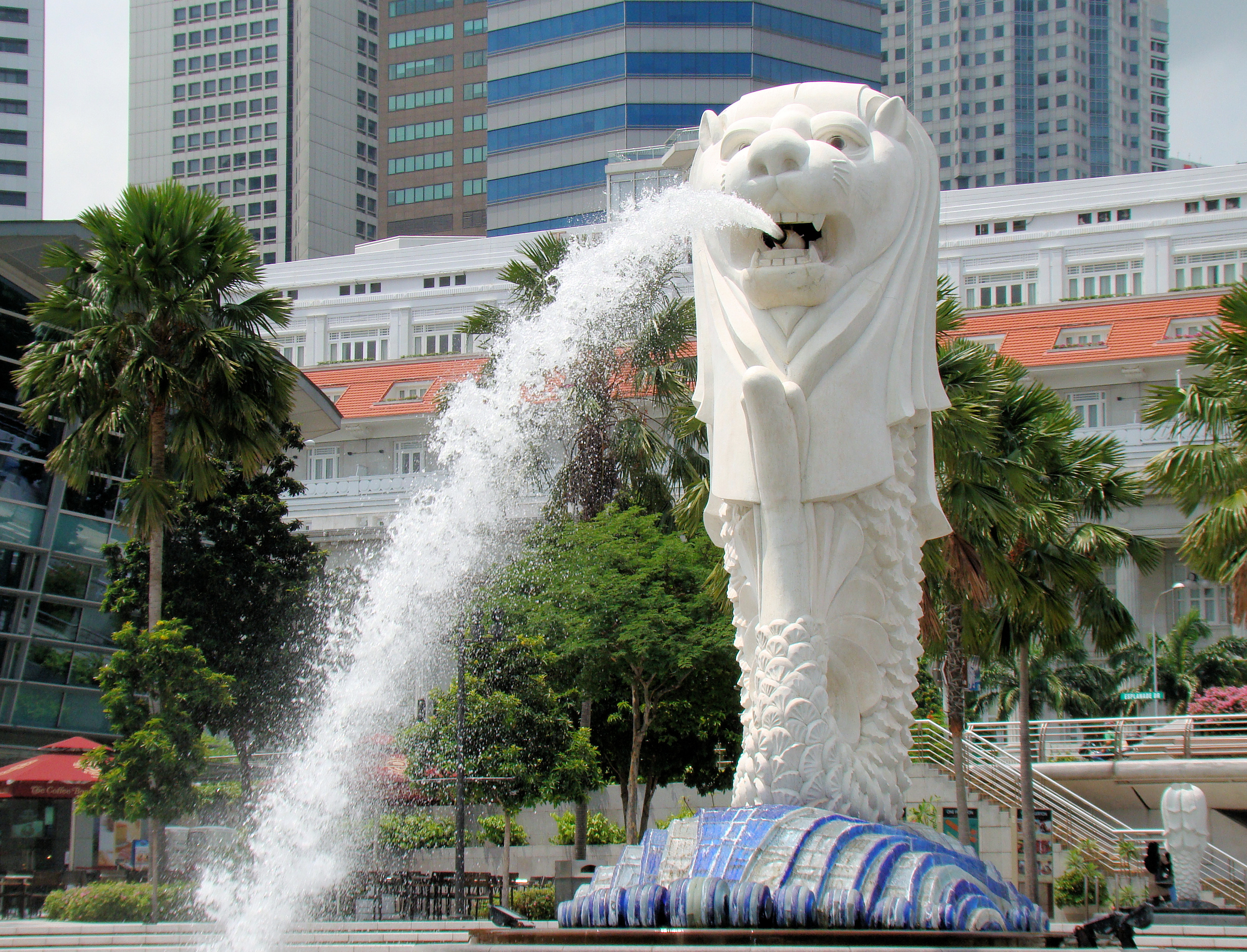
During the 14th century, Singapore has changed its name from Temasek ("Sea Town") to Singapura ("Lion City"). According to legend, Sang Nila Utama, a prince from Palembang decided to visit the island of Temasek out of curiosity. When his ship was out on the sea, a great storm erupted and the ship started to sink. The storm only died down when prince Sang Nila Utama threw his crown overboard and e landed at the mouth of present-day Singapore. He saw a strange animal when he was on a hunt for wild animals. He asked his chief minister what animal it was and was told that it was a lion, therefore renaming the city Singapura, where Singapore's English name derived from.
It was said that the Merlion is a reference to the tale of Sang Nila Utama. The Merlion was designed in 1964 for the Singapore Tourism Promotion Board (STPB), now known as the Singapore Tourism Board (STB). It is a creature with the head of a lion and the body of a fish. While using the fish in the design alludes to the idea of Singapore as a port city and its dependence on maritime trade, the lion head recalls the legend of the discovery of Singapore by prince Sang Nila Utama.
The Merlion has become a marketing icon used as a mascot and national personification of Singapore, representaing Singapore to the rest of the world. Many Merlion statues were build and they serve as tourist attractions. An example is the Merlion Park, which has a four star rating on TripAdvisor. (Evidence) Many from all parts of the world reviewed that the Merlion Park is a place to be visited when traveling to Singapore. Not only that, the Merlion is also widely known among fellow Singaporeans. When asked about the Merlion, I am sure that most Singaporeans are able to explain its origin.
Can we use the Merlion as our national icon? The national icon is a building or structure that can be easily recognized and thus many times used as a metaphor for the certain country. These are popularized by advertisements used to promote the country. Based on the paragraph above, the Merlion indeed fit in the category of Singapore's national icon. The Merlion can unite Singaporeans by creating visual representation of Singapore's history. It can also serve as part of celebrations of patriotism. (Purpose) With the Merlion, Singaporeans will be reminded of Singapore's history as a small fishing village and can be used on events such as National Day. (Implications)
Some may argue that there are many other icons which can outdo the Merlion such as the Changi Airport or Vanda Miss Joaquim. (POV) However, the Merlion has a longer history as compared to other icons. The Merlion was in use by STB from 26 March 1964, much earlier compared to Changi Airport which Terminal 1 was opened in 1981 or Vanda Miss Joaquim which was chosen on 15 April 1981, not to say other newer icons of Singapore. (Evidence) The Merlion's long history allows it to be etched deeper in Singaporeans' minds, hence making it more important to us.
Thus, I conclude that the Merlion can most definitely be used as Singapore's national icon because of how well it fits into the definition of a national icon and its longer history as compared to other icons of the country.
Is Singapore in its Golden Age?
A golden age is a period in a field of endeavor when great tasks were accomplished. Because of the peace and prosperity of the time, arts flourished. An example of a golden age is the Tang Dynasty, the golden age of China.
The Tang Dynasty was founded by the Li (李) family, who seized power during the decline and collapse of the Sui Empire. The Tang dynasty, with its capital at Chang'an (present-day Xi'an), which at the time was the most populous city in the world, is generally regarded as a high point in Chinese civilization: a golden age of cosmopolitan culture. The Tang dynasty was largely a period of progress and stability, except during the An Lushan Rebellion and the decline of central authority in the later half of the dynasty. There was the reinforcement of the central government and the country's military power was strong. Social economy bloomed as sgraiculture made a gradual recovery upon the reunification of the country, land policy was introduced and tax system was adjusted, improvements were introduced in the manufacturing of crafts and the rapid growth of both agriculture and manufacturing industries enabled commerce to fluorish, hence improved transport systems. These led to peace and prosperity during the era which in turn led to arts being flourished.
Similar to the Li family which brought to the golden age of China, Singapore's first Prime Minister Mr Lee Kuan Yew developed Singapore to how it is now. Mr Lee forged a widely admired system of meritocratic, corruption-free and highly efficient government and civil service. He nurtured Singapore into a peaceful, prosperous country. Singapore is free from wars and the country's strict laws prevents many riots and other such activities which will affect the the safety of the citizens from taking place, National Service gives Singapore the ability to defend itself from larger nations, has a Gross Domestic Product (GDP) which is placed 36th in the world, has an strong emphasis on bilingualism and education and much more. Festivals such as Chingay and the many performance arts CCAs in school also allows Singaporeans to showcase our artistic talents. World renowned talents such as singer JJ Lin and filmmaker Jack Neo are Singaporeans. We really have to thank Mr Lee for what we have now.
However, is Singapore really in its golden age? Some may not agree. It is true that Singapore has seen astounding progress over the years but not all that glitters is gold. There are many caught in the cycle of poverty as mentioned in one of my previous blog posts. Many are struggling to survive on a day-by-day basis. The arts too, may not be considered to be flourishing. There are comments which states that Singapore is no place for artists, that Singapore is limiting creativity.
In conclusion, in my opinion, the answer if Singapore is truly in its golden age lies in people's thoughts of Singapore. Some may think that Singapore is in its Golden age while others beg to differ.
Presentation Reflection
The journey to my presentation was definitely not smooth sailing. I had encountered many difficulties and faced many problems during my preparations. Troubles I had while preparing for the actual presentation included the fact that my initial script was too short and that I could not memorize the entire script before the nerve wrecking actual day.
I did not actually overcame all the obstacles. Based on Mr Chua's feedback, I had a large room for improvement. I could have spent more time on memorizing the script, and been more energetic to make up for my soft voice.
However, through this presentation, I had benefited greatly. I learned that to become a successful speaker, practice is inevitable. The same goes for everything in life. There's a saying that goes like this. Practice makes perfect. But is it really true? In my opinion, of course not. Nobody is truly perfect. Despite this, we can strive for excellence. One of RV's school rules states, 追求卓越, Persuit of excellence. We should pursue our aspirations and achieve our fullest potential.
Besides that, I also learned that there you will face difficulties, no matter how big or small, in everything you do. Problems will definitely occur, what can you do? Overcome it! Overcome the challenges coming in your way. Stay strong and brave through the storms. Only when you are fully capable of doing so, you will succeed.
Thus, I am really thankful for the opportunity offered. With the values I had learned instilled in me, I will strive to be the best I can.
China
Since initiating market reforms in 1978,

The rapid economic ascendance shows how
Despite the fact that
I am burdened by the decline in
Excluding the European Union,
Hopefully, the slowdown will stabilize and the economies of many countries will not be negatively affected.
Singapore

Prime Minister Lee Hsien
Loong sounded the alarm that about 170 fewer babies were born here
last year
than in 2008 - a worsening sign of Singapore
fertility
rates. He said: "Perhaps this (the decline) was because of economic
troubles, but, even
so, it (the
flagging fertility rate) is still a grave trend. If unchecked, we will face not
just an aging,
but (also) a
shrinking, population." With the dwindling population growth, Singapore
in many
ways.
Firstly, as the birth rates decrease in
aging
population means that there will be a smaller base of working-age citizens as
more
Singaporeans
retire and fewer Singaporeans enter the work force. Our citizen population and
workforce
will age and decline. Because of this, our economic growth will be affected and
we
will have a
slower economical development. For example, with the ageing population, the
quality of
life for the young can be affected. An increased social and economic pressure
in the
sense that
they have to increase per-capita output in order to support an infrastructure
with
costly,
intensive care for the oldest among their population. The focus shifts away
from the
planning of
future families and therefore further degrades the rate of procreation.
Secondly,
'shortage'
of Singaporeans if there is no spike in birth rates. This affects the safety of
our
country as
there will not be enough Singaporeans who step up and defend our nation in the
event of a
crisis.
On the positive side, the small work force increases the demand for labor, which can potentially
result in a
reduced unemployment rate as well as higher wages. This does not happen in
countries
with high population such as China
and India
Based on the above points, in my opinion, the decrease of economic growth and the defense of
our country
is more important than high wages.
One measure
to give
subsidies for the birth of each baby. As having and raising a baby costs a huge
sum of
money,
government help can attract more people to think of having a baby as they can
find it
easier to
raise a child.
On top of these subsidies, the
active part
in the upbringing of a child. In this way, the women will be more comfortable
with
having a
child. Compared to the past, more women are entering the work force. As such,
balancing a
family and a career can be challenging. Hence, this links back to my point of
men
needing to
take a more active role. Research showed that those rejected in childhood felt
more
anxious and
insecure as well as hostile and aggressive.
However,
this have led to protests as community pressure is forced onto the government
to
reduce the
intake of foreigners for they are concerned about the weakening of our social
cohesion
that we have worked hard over the years to build. I suggest that the government
can
inform the
citizens about the importance of recruiting foreigners for I know that doing so
was
definitely
not a spur in the moment decision.
Not only the two measures above, I feel that young Singaporeans should be educated on the problem of the dwindling population growth through schools and campaigns. Singaporeans now are very tech savvy, thus I propose that more information about matter should be introduced through digital methods. With the knowledge of the problem, they will be able to find out more about the matter through various means. Only when the future generation knows about the current problems will I think that they can change
In conclusion, based on the fact that the economic development is slowing down and that there
are not
enough citizens to protect our country, I feel that the dwindling population
growth is very
worrying.
Measures such as the government providing subsidies, men taking a more active
part
in the
taking care of the child and recruiting foreign talents should be taken.
Poverty In Singapore
Do you know that although
I was surprised to find that despite the fact that
Because of
I feel that this issue should definitely not be taken lightly. It was heart breaking to find that people are fighting for survival daily. In my opinion, I think that we should all make an effort in helping the needy. We can all do our part by spreading awareness of the poverty in
There is also a tinge of guilt in my heart. Being born in an average
I feel that the poor do not deserve to go through that arduous life full of hardships. All should have the right to have control over their lives instead of stressing over household expanses. A little kindness goes a long way. I hope that with this blog post, people can know more about the seemingly invisible poverty in
Holiday Reflection
Although it is sad that I
did not have the chance to travel overseas last holiday, I had a great time
experiencing new things with my friends. Some highlights of my holiday include
watching the long awaited movie "The Hunger Games: Mockingjay" late
at night, playing around in the trampoline park, going bowling and playing
laser tag. In my opinion, it is thrilling and exciting to experience things
that I have never done in my life before as it gives me the sense of
accomplishment after trying them out. Furthermore, hanging out with my friends
is not only a way to relieve stress, I find that it is also a method to
strengthen our bonds and also form new friendships.
I enjoyed returning to
school too. My partner and I had to either invent or modify an existing product
to partake in the Tan Kah Kee Young Inventors' Award Competion. The DnT project
work that my partner and I had to complete helped me learn more about design
and technology, thus increasing my interest in the subject.
Other than that, as I am in
Chinese Drama, the extra cca sessions I attended in the holidays had allowed me
to forge closer relationship with my seniors and cca mates. We became much more
comfortable with each other through games and discussion. I am relieved and
elated to find that our cca members are much closer after those sessions.
However, I find it regretful
as I have spent much of my time lazing in my house instead of making good use
of the time to study. I am sure that some people re watches interesting shows
and dramas repeatedly. I am one of those slackers. I spent a lot of time on
YouTube, social media and surfing the Internet. I feel that I should have been
more productive by revising the content taught last year and reading the
textbooks to have a conception on the topics that will be covered this year.
Hence, I strongly feel that I should have managed my time better. Looking back,
I regret not being productive. I should have limited the time I spent lazing
around and used it wisely.
This upcoming March holiday,
I am will definitely be more self disciplined. I will restrict the amount of
time spent on unimportant matters and focus more on my studies with the
determination to improve my grades.
In conclusion, I feel that I
had a rather relaxing and simple holiday but it could have been much more
fruitful and meaningful if I had given myself adequate time to study and play.


No comments:
Post a Comment